Friday, August 29, 2008

Thank god I got one


When I was 8 years old my mother bought me the Golden Book of the Civil War at a local garage sale. I read the book from cover to cover and at that time I was really interested in the presidents, particularly Lincoln and she thought that the book would supplement that interest. Little did she know that it would grant me the lifelong love that I have for the American Civil War.

The book was written by Charles Flato and distributed by Golden Press Publications. Civil War author Bruce Catton wrote the books introduction and its colorful depectitions of battlefields is amazing. In just 216 pages the book sweeps its readers back to the Civil War time period but the best thing about this book is that it is made for young readers. When I was eight this book made the war come alive for me and since it was written during the centennial of the Civil War it is especially memorable. This book is written in style very similar to a textbook. I found it interesting, and it would be especially good for younger readers who are interested in learning more about the Civil War. One of the strengths of the book was the photos as well as many paintings and drawings that came from the period of the Civil War. These give the reader a picture of the scenes of war. Other helpful things found in the book are maps of battlefields with explanations of what took place and in what areas. The book might be a little old and outdated, but it is still very helpful in explaining more of that awful period of American history.

I love this book but the original copy that my mother bought me has been misplaced so I managed to acquire a copy from a online book seller. Thank god that I have a copy to give to my own son or daughter. I can only hope that they love the Civil War as much as their dad does. Thanks mom!

Saturday, August 23, 2008

Robert E. Lee Timeline or Lifeline

Recently, I've wanted to create a Robert E. Lee timeline for fun. Yes I am such a history nerd but that is what makes me so cool.

Robert E. Lee Timeline

1807 January 9 Robert Edward Lee is born at 'Stratford', Westmoreland County, Virginia
1829 _______ Lee graduates from the United States Military Academy at West Point.
1831 May 7 Arrives at Fortress Monroe for duty.
1831 June 30 Robert Edward Lee and Mary Anne Custis marry.
1832 September 16 George Washington Custis Lee is born.
1835 July 22 Mary Lee is born.
1837 May 30 William Henry Fitzhugh Lee is born.
1839 June 18 Annie Carter Lee is born.
1841 February 27 Elanore Agnes Lee is born.
1843 October 27 Robert Edward Lee, Jr., is born.
1846 February 10 Mildred Childe Lee is born.
1852 September 1 Lee assumes his duties as Superintendent of the United States Military Academy at West Point.
1853 July 17 Lee is Confirmed into the Episcopal Church.
1859 October 17 Lee is ordered to the War Department in regards to John Brown's raid on Harper's Ferry. 1859
1859 October 18 Lee leads a command of United States Marines to capture John Brown and his cohorts at Harpers Ferry.
1860 February 9 Lee is ordered to San Antonio, Texas, to take command of the Department of Texas.
1861 April 20 Robert E. Lee resigns his commission in the United States Army.
1861 May 14 Lee is appointed Brigadier General in the Confederate States Army.
1861 June 14 Lee attains the rank of General in the Confederate States Army.
1862 May 31 Joseph E. Johnston is wounded at the Battle of Seven Pines.
1863 July 1-3 Battle of Gettysburg. MORE
1865 April 2 Lee orders the Abandonment of Petersburg, Virginia.
1865 January 23 Lee is named General in Chief of the Armies of the Confederate States.
1866 February 17 Lee appeares before the Joint Committee on Reconstruction on Capitol Hill.
1870 October 12 Robert E. Lee dies in Lexington, Virginia
1975 July 22 Congress Passed a law restoring Lee's Citizenship.
1975 August 5 President Gerald Ford signs in to law the bill Congress passed restoring Lee's Citizenship to the United States.

Thursday, August 14, 2008

Busy but I got a job

Hello everyone,

Sorry that I have not produced many blogs since June but I finally got my first real gig as a teacher and I have been busy preparing lessons and trying to envision my classroom. More blogs will be produced soon. I want to thank everyone who stood by me all these years including Megan, my parents, and the rest of my family & friends. Thank you.

Sunday, August 10, 2008

Today and the future

The Battle of Wilson's Creek occured one this date in 1861. I do have to announce that I finally recieved a full-time teaching job so my lack of posts this summer will not drastically increase as the year goes on. However, expect more posts soon! I am in the process of getting the Golden Book of the Civil WAr and that was the first Civil WAr book that I ever got but I have been unable to find my original copy. I am purchasing a copy off of Ebay.

Tuesday, July 22, 2008

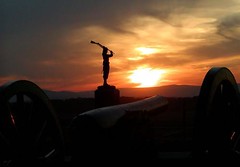
Great Gettysburg Photo


Gettysburg
Originally uploaded by Green Destiny
A beautiful photo at Gettysburg that was taken by a tourist and posted on flickr. I liked it so much that I thought that I would share it with my readers. It is a great view of the sunset near the angle and I love the use of the statue and the cannon. A great view of the "High Tide of the Confederacy".

Friday, July 18, 2008

Fort Battery Wagner


Today, 145 years ago the 54th Massachusetts Regiment attacked an unattainable position at Fort Battery Wagner, South Carolina. The All-black regiment was led by a white colonel named Robert Gould Shaw. Colonel Shaw was killed, along with one-hundred and sixteen of his men. Another hundred and fifty-six were wounded or captured. The regiment's bravery and sacrifice destroyed any stereotypes that white soldiers had about black soldiers. A newspaper write wrote of the regiment "The Fifty-fourth did well and nobly. . . . They moved up as gallantly as any troops could, and with their enthusiasm they deserved a better fate." The 1989 film Glory tells the story of the 54th. After the battle the Confederates did not feel that the black troopers were worth a grain of salt. They unceremoniously buried in a mass grave and Shaw was buried in the burial pit with his soldiers. The poor burial choice reinforced the public's feelings towards the regiment. Black history would never be the same and the race was well on its way to recieve the American citizenship that they so much deserved.

A casualty list for the regiment can be found here:

http://www.archives.gov/exhibits/american_originals/54thmass.html

http://www.us-civilwar.com/54th.htm

Thursday, July 17, 2008

A Generals Graveyard: The Battle of Franklin


The Confederate charge at Franklin completely destroyed a Confederate army and became the final major Confederate assault of the war. The cost of the battle is best told by the official casualty numbers, 1,750 men were killed and another 3,800 were wounded. An estimated 2000 others suffered less serious wounds. But the biggest loss for the Confederacy was in its officer ranks which were decimated in the attack.


Fifteen Confederate generals (6 killed or mortally wounded, 8 wounded, and 1 captured) and 53 regimental commanders were casualties.

Divisional Commanders KIA

Major-General Patrick Cleburne

Brigade Commanders KIA

Brig. Gen. John Adams
Brig. Gen. Hiram B. Granbury
Brig. Gen. States Rights Gist
Brig. Gen. Otho F. Strahl

Brigade Commanders Mortally Wounded

Brig. Gen. John C. Carter

Brigade Commanders Wounded

Brig. Gen. Arthur M. Manigault
Brig. Gen. Thomas M. Scott
Brig. Gen. Francis M. Cockrell
Brig. Gen. William A. Quarles
Brig. Gen. Zachariah C. Deas
Brig. Gen. John C. Brown
Brig. Gen. Arthur M. Manigault
Brig. Gen. Ellison Capers

Brigade Commanders Captured

Brig. Gen. George W. Gordon

As Shelby Foote once put it "The flower of the army fell" at Franklin. That may be true but surely no other battle in Civil War history claimed more top commanders than the Battle of Franklin. The leadership of the Army of Tennessee had been shot away. Major General Benjamin F. Cheatham's Corp command suffered the highest number of high command casualties. Its casualty list included; Cleburne, Granbury, Brown, Gist, Carter, Strahl were killed or wounded. Gordon became the seventh officer lost when he was captured. Lt. General Alexander P. Stewart's corps suffered as well and four of its generals were killed or wounded (Adams, Scott, Cockrell & Quarles).

I hope that everybody is enjoying their summers!

Saturday, July 12, 2008

Just a cut and paste

Many Blogs ago I wrote about General Albert Pike in my Fogotten Generals of the Civil War Series. On July 12, 1861 Pike was involved in a key treaty with several Native American Tribes. Today's blog is just a cut and paste from History Channel.com but I think it is a great read.


Special commissioner Albert Pike completes treaties with the members of the Choctaw and Chickasaw Tribes, giving the new Confederate States of America several allies in Indian Territory. Some members of the tribes also fought for the Confederacy.

A Boston native, Pike went west in 1831 and traveled with fur trappers and traders. He settled in Arkansas and became a noted poet, author, and teacher. He bought a plantation and operated a newspaper, the Arkansas Advocate. By 1837 he was practicing law and often represented Native Americans in disputes with the federal government.

Pike was opposed to secession but nonetheless sided with his adopted state when it left the Union. As ambassador to the Indians, he was a fortunate addition to the Confederacy, which was seeking to form alliances with the tribes of Indian Territory. Besides the agreements with the Choctaw and Chickasaw tribes, Pike also engineered treaties with the Creek, Seminole, Comanche, and Caddos, among others.

Ironically, many of these tribes had been expelled from the Southern states in the 1830s and 1840s but still chose to ally themselves with those states during the war. The grudges they held against the Confederate states were offset by their animosity toward the federal government. Native Americans were also bothered by Republican rhetoric during the 1860 election. Some of Abraham Lincoln's supporters, such as William Seward, argued that the land of the tribes in Indian Territory should be appropriated for distribution to white settlers. When the war began in 1861, Secretary of War Simon Cameron ordered all posts in Indian Territory abandoned to free up military resources for use against the Confederacy, leaving the area open to invasion by the Confederates.

By signing these treaties, the tribes severed their relationships with the federal government, much in the way the southern states did by seceding from the Union. They were accepted into the Confederates States of America, and they sent representatives to the Confederate Congress. The Confederate government promised to protect the Native American's land holdings and to fulfill the obligations such as annuity payments made by the federal government.

Some of these tribes even sent troops to serve in the Confederate army, and one Cherokee, Stand Watie, rose to the rank of brigadier general