Yes it has been a while but a fascinating post on a new blog on Gettysburg that I just love.
http://gettysburg150th.wordpress.com/2011/02/18/a-life-snuffed-out-in-battle/
Showing posts with label Gettysburg. Show all posts
Showing posts with label Gettysburg. Show all posts
Monday, February 21, 2011

Wednesday, September 15, 2010
WWII at Gettysburg
Great post on Gettysburgdaily.com Its good to know that the town's voice was heard during WWII. Of the 494 killed over 400 died in combat. Now that is sacrifice.
http://www.gettysburgdaily.com/?p=8610
http://www.gettysburgdaily.com/?p=8610
Saturday, March 27, 2010
Gettysburg Daily

Fascinating posts at Gettysburgdaily.com. They are doing an exclusive on Little Round Top and its impact on history. I have read the host's (Gerry Adelman) books and he has an intersting take on the historgraphy of that small, rocky hill in southern PA.
Here are the links to the posts:
Part 1: http://www.gettysburgdaily.com/?p=7132
Part 2: http://www.gettysburgdaily.com/?p=7173
Part 3: http://www.gettysburgdaily.com/?p=7183
Tuesday, February 9, 2010
Good man
Murtha’s passion for history saved the Cyclorama painting.
Late lawmaker secured $16 million in Congressional funds to restore timeworn painting.
Published: Monday, February 8, 2010 6:38 PM EST
The late John Murtha will be remembered across the Commonwealth of Pennsylvania as a Vietnam war veteran, an outspoken critic of the Iraq War, and a lawmaker that often brought home “pork” to his constituency.
Here, he’ll forever be known as the man that secured $16 million in federal dollars to restore the Cyclorama painting at Gettysburg National Military Park.
Murtha died Tuesday at 77-years-old.
Over a nine year period from 2000-09, the Johnstown area legislator earmarked chunks of funding in the Congressional budget, to conserve the Civil War era artwork — even though he did not represent this area in Washington.
Info taken from http://www.gettysburgtimes.com/articles/2010/02/08/blogs/doc4b70a073b8786513746541.txt
Late lawmaker secured $16 million in Congressional funds to restore timeworn painting.
Published: Monday, February 8, 2010 6:38 PM EST
The late John Murtha will be remembered across the Commonwealth of Pennsylvania as a Vietnam war veteran, an outspoken critic of the Iraq War, and a lawmaker that often brought home “pork” to his constituency.
Here, he’ll forever be known as the man that secured $16 million in federal dollars to restore the Cyclorama painting at Gettysburg National Military Park.
Murtha died Tuesday at 77-years-old.
Over a nine year period from 2000-09, the Johnstown area legislator earmarked chunks of funding in the Congressional budget, to conserve the Civil War era artwork — even though he did not represent this area in Washington.
Info taken from http://www.gettysburgtimes.com/articles/2010/02/08/blogs/doc4b70a073b8786513746541.txt
Saturday, November 28, 2009
Various casuality reports for Lee's Army at Gettysburg

Various casualty reports for Lee's Army at Gettysburg
Confederate reports for its losses at Gettysburg have always been questioned by historians. Many units underreported their losses or did not report as many losses as they obviously suffered. Determining the casualty lists for either side during the war is very difficult. But looking at Busey and Martin's book on the subject sheds some light on things. Growing up I always thought that Lee lost 28,000-30,000 men at Gettysburg but was that the case??
Lafayette Guild. Medicial Director of the Army of Northern Virginia reported 14,278 casualties in 1889.
Also in 1889 the War Department published 20,451 casualties at Gettysburg.
Details: 2592 killed, 12,709 wounded, 5,150 captured or missing
William F. Fox and his infamous study on the wars casualties reported Lee's losses at 20, 448
Details: 2592 killed, 12, 706 wounded 5,150 missing, he also noted a few thousand captured
The official reports of Lee's Corps commanders (Ewell, Longstreet, Hill and Stuart) reported 22,968 casualties.
Details: 2,701 killed, 12,739 wounded, 7,528 missing.
Historian Thomas L. Livermore calculated the Confederate casualties to be 28,063 which is the number that I most remember.
Details: 3,903 killed, 18,735 wounded and 7,528 missing, Livermore felt that the Confederate Corps commanders underreported their losses.
HIstorian Robert Krick estimated a loss of 22,915 men for Lee and his beloved army.
Details: 4,649 killed, 12,420 wounded and 5,830 missing
Busey and Martin whose book I am using for this post reported that Lee lost 23,231
Details: 4,708 killed, 12,693 wounded and 5,830 missing
Source:
Busey, John W. Regimental Strengths and Losses at Gettysburg. New York: Longstreet House, 2005.
Thursday, November 26, 2009
Saturday, November 7, 2009
Book Review #13 The Complete Gettysburg Battlefield Guide

Since those warm days in 1863 the Battle of Gettysburg has had the ultimate distinction of having more books published about it than any other military campaign in American history. After the guns fell silent the men and women who partcipated in the battle published first-hand accounts which were ultimately followed by more secondary sources than most people can count. The battle has been disceted by authors for years and the publishing world has produced books solely based on the action on specific parts of the battlfield. For example, some authors have focused on the action on Little Round Top or the Wheatfield or the unfinished railroad cut or Pickett's Charge. The battle has also seen the publication of several tour guide books over the years which provide visitors with the opportunity to use them during their trips to the site. One would think that with so many books published on the subject that nobody could come up with anything unique but noted Gettysburg historian J. David Petruzzi & Civil War cartographer Steven Stanley have produced a book whose ownership is required by anyone interested in Gettysburg or the Civil War.
The book itself comes in hardcover and has an excellent dust jacket which depicts General Warren's statue on Little Round Top. The book is sturdy and purchasers will be happy to see that every page is on thick, glossy paper which should allow the user to use it on the battlefield. Also, the book is in full color and that makes both the locations and the information come alive for the reader. The book would not have the impact that it does if it was in black and white. This book is unbelieveable!
The book is the result of a perfect partnership between authors JD Petruzzi and Steve Stanley. The latter is a cartographer who creates maps for The Civil War Presevervation Trust. His maps are colorful, easy to read but very detailed. In all the book contains 70 maps and dozens of photos by Stanley which supplement Petruzzi's easy to read and detailed text. In fact, this book is not only a must for Gettysburg lovers but because the text is not overly detailed makes this a book that is easy to use on the battlefield or read on your armchair.
The contents of the book make the purchasing price seem ambigious. This book is worth every dollar that you will spend on it. First, it contains excellent introductions by Petruzzi, Stanley and Gettysburg Battlefield Guide Eric Campbell. Campbell also appears in Civil War Tours as a audio tourguide. Wisely the authors have a short section entitled "Helpful Hints for using the Guide" which briefly explains how the reader should use the book and encouragers vistors to the Gettysburg battlefield to get out of their cars and walk the grounds. You can easily tell that both Stanley and Petruzzi love this campaign, the fields on which it was fought and are passionate about educating people about the battle.
Another wise thing that Petruzzi did a nice 8 page overview of the entire Gettysburg campaign. This is a wonderful addition because newcomers to the battle will find it very interesting and it allows them to quickly educate themselves on the situation that both Meade/Hooker and Robert E. Lee faced from the day the campaign started to the last rebel crossed the Potomac River. Also, this overview is written so well that Gettysburg experts will find it a worthy read.
The bulk of the book contains 11 seperate tours of the Gettysburg battlefield and other surrounding areas. The first tour takes the readers to the site of a little known and overlooked skirmish between Confederate cavarly and the 26th Pennsylvania Milita. Chapter 2-3 take the readers through the key stops on July 1-3 1863. Like all the tour chapters, each stop on the tour is detailed and almost always a photograph is included. Stanley's excellent maps and photos support Petruzzi's writings and both keep the readers interest. The next three tours deal with the caverly action around the Gettysburg battlefield which includes the sometimes overlooked East Caverly Battlefield, Hunterstown and Fairfield.
The seventh tour in the book takes the readers to the imporant sites in the town of Gettysburg area. These historical sites include but are not excluded to the town square, the Gettysburg rail station, Thaddeus Stevens' office, the imfamous "Jennie" Wade House and the Harvey S. Sweney House which is now known as the Farnsworth House. In all the town tour has 22 stops and all are detailed by Petruzzi.
The next two tours bring the readers into two cemetarys. The first is a tour of the Soldiers' National Cemetery and the second is a tour of the lesser visited Evergreen Cemetery. Some of the fascinating graves that the authors discuss are the graves of James Gettys (founder of Gettysburg) and the Gettysburg Civil War Women's Memorial. Another interesting stop is the gravesite of Gettysburg resident Edward Stewart Plan who is a member of the Professional Baseball Hall of Fame. In all the Evergreen Tour is 37 exciting stops. Petruzzi also points out the actual location of the Speakers' Platform that was used for the Gettysburg Address. Of course the graves of "Jennie" Wade, Jack Skully and John Burns are also included.
A truely intriguing addition to the book is 21 stop tour of the battlefield's rock carvings. According to Petruzzi he included this section to catch the interest of vistors who tend to focus on the main parts of the battlfield and "often miss" the "out-of-the way locations. Many soldiers carved their names on the battlfield to point out the fact that they were there and in several cases the reader will have to leave their car to explore them. I cannot think of any other publication taht includes a review of these sites. One of the more interesting carvings to me is a 1889 carving by a member of the 143rd Pennsylvania on McPherson's Barn. For each carving Petruzzi includes the offical location, easy to follow directions and never before published photographs of each.
The owner of this book will have a series of excellently written tours. It will stand up to repeated use and it will be the final say on Gettysburg Tour books for years to come. If you own other Gettysburg Tour books you may want to toss them out because the Complete Gettysburg Guide is all you will ever need! Any Gettysburg enthusiast will be happy with this book. Although one could be a nitpicker and point out things that should have been included I highly doubt that you will ever find anything better. If you are interested in learning about Gettysburg then you must purchase this book.
Sources:
The books webpage is located at: http://www.completegettysburgguide.com/about.htm
Tuesday, November 3, 2009
Finally got it!

This week I finally got my copy of JD Petruzzi's "The Complete Gettysburg Guide" which I have been waiting anxiously for. I recently joined the Civil War Preservation Trust and with my 100 dollar donation I got Petruzzi's book, a jacket (which still hasn't come yet), a tax break (Thank you Obama), and a yearly subscription to the preservation society. I am so excited and a book review on the guide is in the works! Stay Tuned!
Gettysburg "kick" Continues

My July 09 trip to Gettysburg is still impacting my reading. I have just finished the 1958 biography of Major General John F. Reynolds who was killed at Gettysburg and the new "Fog of Gettysburg" which was an interesting read. I'm trying to quit but now I am reading Jeffery Wert's book on the third day at Gettysburg and after that I will read JD Petruzzi's book "The Complete Gettysburg Guide". After that I will stop...I promise.
Monday, October 19, 2009
Little Round Top
I sat there alone on the storied crest, till the sun went down as it did before the misty hills, and the darkness crept up the slopes, till from all earthly sight I was buried as with those before. But oh, what radiant companionship was election around, what steadfast ranks of power, what bearing of heroic souls. Oh, the glory that beamed through those nights and days. Nobody will ever know it here!- I am sorry most of all for that.” May 1913
Gettysburg Super with too much time on his hands
The leader of one of this nation's most important national parks is too busy doing other things but his job
http://www.washingtonpost.com/wp-dyn/content/article/2009/10/18/AR2009101802380.html
http://www.washingtonpost.com/wp-dyn/content/article/2009/10/18/AR2009101802380.html
Wednesday, October 14, 2009
Gettysburg meets Vietnam
GETTYSBURG, ADAMS COUNTY - The moving Vietnam War Memorial Wall makes it's second last stop as part of a year long tour through the United States. The wall commonly known as the "Wall that Heals" has been traveling since 1996, and today made a stop at Gettysburg College. The wall lists 58,261 names of people who died in Vietnam, and now people in charge of the the wall said they are looking for photos of sericemen and women to add to the wall.
"The best part for us in in having the veterans come out and have that time to heal the wounds they received during the war," said the program manager of the wall, Dan Schenk.
The wall is now on it's way to Wisconsin, where it will end it's journey for the time being.
Source: Copyright © 2009, WPMT-TV
"The best part for us in in having the veterans come out and have that time to heal the wounds they received during the war," said the program manager of the wall, Dan Schenk.
The wall is now on it's way to Wisconsin, where it will end it's journey for the time being.
Source: Copyright © 2009, WPMT-TV
Friday, September 25, 2009


Born in 1821 George Nixon would not achieve the level of importance that his great-grandson would as the 37th President of the United States. He served during the Civil War as a Private in Company B, 73rd Ohio Volunteer Infantry. During the second day of the Battle of Gettysburg (July 2, 1863), he was wounded in the right hip and side during skimishing with the Confederates, and lay in the no-man's land between the Union position on Cemetery Hill and the Rebel's hold on the town. At night his cries of pain were such that it inspired Musician Richard Enderlin to crawl out during the constant firing between the two forces, drag Private Nixon back most of the way, then stand up with the wounded man in tow and dash the final distance to safty. This act won Richard Enderlin a instant promotion to Sergeant, and a Medal of Honor 34 years later. Despite his rescue, Private Nixon's wounds proved to be mortal, and he died in the XI Corps Hospital seven days later. His great-grandson, Richard Millhouse Nixon, would become a president and serve eight years as the nations vice-president. During the Presidential election of 1960 Nixon would also lose one of the most famous elections in American History to John F. Kennedy.
Currently, Nixon's remains lie in the National Soldiers Cemetery at Gettysburg. According to the NPS website Richard Nixon visited his great-grandfathers grave during his tenure as vice-president.
Sources:
http://www.nps.gov/archive/gett/getttour/tstops/tstd4-23.htm
http://www.ghostpapers.com/term-papers-site/free-term-papers/POLITICS/free-term-papers-RICHARD-NIXON-THE-37TH-PRESIDENT.html
Fascinating fact
I was born and raised in New York but live in Ohio. Recently I cam across some numbers that stated that Ohio had over 4,400 men serving at Gettysburg. Only Pennsylvania, New York, and Massachusetts had more men on the battlefield. Ohio had men serving in the 2nd, 5th, 11th and 12th Corps, along with the artillery and cavalry corps.
Thursday, September 10, 2009
Underratted Gettysburg book gets its just due
July 2 and July 3 1863 seem to get their just due in several books which means that July 1st often gets overlooked. Historian Harry Pfanz has written an excellent book that focuses on the first day of the battle but its recent publication overshadows David G. Martin's 1995 publication Gettysburg July 1. Although Pranz does an excellent job (he always does) Martin's book details the battle on July 1st in greater detail and provides even more insight on the combat. A review on Amazon.com accurately describes the book as "Martin's Gettysburg, July 1 is now the standard source for the first day's fight." -- Civil War Regiments.
Perhaps the best thing about this book is the way that Martin is able to cover the micro and macro parts of this epic contest that began early on July 1st. Amongst its 736 pages are three extra chapters which provide the reader with the usual Order of Battle and two other interesting additions. Appendex 2 is an outstanding account of the topography of the first day's battlefield and of the road network surrounding Gettysburg. The third appendex is a brief but good overview of the weather leading up to and during the battle. Both Appendex 2 and 3 are a must for any Gettysburg buff.
The maps of this book are unique. Most Gettysburg books use the same maps but Marting goes a step further. The maps are of two kinds: a "situation" map showing the position of the troops at a given point in time and an "action" map focusing on an incident of the battle. Perhaps the biggest reason that so many authors have avoided writing a book that just focuses on day one was the fateful decision of Richard Ewell to avoid any further entaglements with the Federals after they had been repulsed to Cemetery Hill/Culps Hill. I don't want to reveal everything that Martin talks about but his analysis/opinions shift the blame off Ewell's shoulders. I won't say where he places it but I am sure that you can take a guess. I highly suggest that you read this book for yourself and make your own descision. Again it isn't as recent as Pfanz's book but is superior to that work in so many ways. Highly recommended.
Perhaps the best thing about this book is the way that Martin is able to cover the micro and macro parts of this epic contest that began early on July 1st. Amongst its 736 pages are three extra chapters which provide the reader with the usual Order of Battle and two other interesting additions. Appendex 2 is an outstanding account of the topography of the first day's battlefield and of the road network surrounding Gettysburg. The third appendex is a brief but good overview of the weather leading up to and during the battle. Both Appendex 2 and 3 are a must for any Gettysburg buff.
The maps of this book are unique. Most Gettysburg books use the same maps but Marting goes a step further. The maps are of two kinds: a "situation" map showing the position of the troops at a given point in time and an "action" map focusing on an incident of the battle. Perhaps the biggest reason that so many authors have avoided writing a book that just focuses on day one was the fateful decision of Richard Ewell to avoid any further entaglements with the Federals after they had been repulsed to Cemetery Hill/Culps Hill. I don't want to reveal everything that Martin talks about but his analysis/opinions shift the blame off Ewell's shoulders. I won't say where he places it but I am sure that you can take a guess. I highly suggest that you read this book for yourself and make your own descision. Again it isn't as recent as Pfanz's book but is superior to that work in so many ways. Highly recommended.
Monday, August 31, 2009
New Gettysburg museum has an interesting artifiact

In Gettysburg a recently opened museum called the "Gettysburg Museum of History" opened recently and hosts over 4,000 arifacts. One of the interesting items is a pair of bullets that met in mid-air and merged. (see picture). The museum is free and opened just three weeks ago and one week after I visited the area in late July 2009. The currator of the museum has ancestors who farmed much of the area where Pickett's Charge took place and as he dug up things during his work he kept them and past them down to his decedents.
According to an 1887 newspaper account that Dorr (the museum manager) located, Pfeffer discovered a burial trench with the bodies of seven Confederate soldiers located near what is now the 12th New Jersey monument. Dorr said his great-great grandfather kept buttons and other momentos from the bodies, then re-buried the bones.
"As far as I know, they're still there," he said.
Hours: 11 a.m. to 7 p.m. Tuesday through Sunday
Location: 219 Baltimore St., Gettysburg
I have to say that I am very disappointed that this didn't exist during my visit to Gettysburg. I guess that it is another reason to go back.
Tuesday, August 11, 2009
Book Review #12 "The Myth of Little Round Top" by Garry E. Adelman
Since my Gettysburg trip is still in the recent past I figured that my next book review should focus on a Gettysburg book. Remember reading your history and learning that if the Confederate army had succeeded in carrying Little Round Top then they would have won the battle? Author Garry E. Adelman states that this version of history is false and he wrote a 100 page book to discuss his views and thesis.
If i revealed Alderman's viewpoints then it would ruin the book for you so instead I will focus on what you get with the book which is modestly prices at $12.95. Adelman incudes three appendix which will be my focal point here. The first appendix is the sterotypical Order of Battle for both sides during the battle. That is usually in every Gettysburg book so I will not speak anymore of it. The second appendix includes the casuality list for those regiments who were engaged at Little Round Top on July 2, 1863. Incuded are the number engaged, killed, wounded, missing, totals, and % Lost.
The third appendix is awesome. Standing alone the third appendix is worth the purchase if you are interested in this part of the battle. In this appendix, Alderman lists the major primary and secondary sources in what he calls a "historiography of Little Round Top". This includes a chart of one hundred or so sources written about the struggle for that rocky hill to show how the views of Little Round Top has changed over the years. The list is chronologically through time, by type of source the manner of importance placed upon Little Round Top by the author. You can see how each source explains the importance of Little Round Top. Its great stuff and should you get the opportunity to purchase this book it is highly recommended.
As a final note, his reasoning for the myth is broken in chapter one with a history of fight for Little Round Top, the second chapter explores the Legend of Little Round Top and how it grew ove the course of the latter part of the 1800's and the early 1900's. The final chapter deals with the military analysis of Little Round Top and what would or could have happened if the Confederates had taken that hill. the answer to that question might surprise you. If you get a chance purchase Garry E. Adelman's "The Myth of Little Round Top".
If i revealed Alderman's viewpoints then it would ruin the book for you so instead I will focus on what you get with the book which is modestly prices at $12.95. Adelman incudes three appendix which will be my focal point here. The first appendix is the sterotypical Order of Battle for both sides during the battle. That is usually in every Gettysburg book so I will not speak anymore of it. The second appendix includes the casuality list for those regiments who were engaged at Little Round Top on July 2, 1863. Incuded are the number engaged, killed, wounded, missing, totals, and % Lost.
The third appendix is awesome. Standing alone the third appendix is worth the purchase if you are interested in this part of the battle. In this appendix, Alderman lists the major primary and secondary sources in what he calls a "historiography of Little Round Top". This includes a chart of one hundred or so sources written about the struggle for that rocky hill to show how the views of Little Round Top has changed over the years. The list is chronologically through time, by type of source the manner of importance placed upon Little Round Top by the author. You can see how each source explains the importance of Little Round Top. Its great stuff and should you get the opportunity to purchase this book it is highly recommended.
As a final note, his reasoning for the myth is broken in chapter one with a history of fight for Little Round Top, the second chapter explores the Legend of Little Round Top and how it grew ove the course of the latter part of the 1800's and the early 1900's. The final chapter deals with the military analysis of Little Round Top and what would or could have happened if the Confederates had taken that hill. the answer to that question might surprise you. If you get a chance purchase Garry E. Adelman's "The Myth of Little Round Top".
Sunday, August 9, 2009
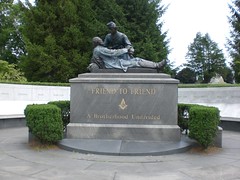
Friend to a Friend Monument
Back when I visited Gettysburg in 1986 and 1989 the "Friend to a Friend" monument was not yet built. I was really happy to see it during our 2009 trip to Gettysburg. I thought I'd share this pic with everybody because it is a great view of this monument.
Monday, August 3, 2009
Little Round Top after 20 years


Its been 20 years since I walked the hill of Little Round Top. I know that historians today have researched the fact that the drama that unfolded on that rocky hill in July of 1863 is overrated and overshadows the situation that occurred further north at the Peach Orchard, The Wheatfield, Devils Den and the lower part of Cemetery Ridge. But as I have written in earlier blogs (Blog 1 & Blog 2) I love Little Round Top. I still believe that it was the most important part of the Gettysburg battlefield regardless of its importance being overrated.
Another cool thing about the trip was that I brought my 11 year old nephew to the battlefield. The first time that I went to Gettysburg was in 1986 and I was only slightly younger than my nephew is and it was exciting to show him to the battlefield. I already want to go back to Gettysburg.
Sunday, August 2, 2009
Gettyburg 2009
As you may know I travelled to Gettysburg last week and enjoyed the town and the battlefield. Pics and a blog about it will be coming soon. Stay tuned!
Subscribe to:
Posts (Atom)


